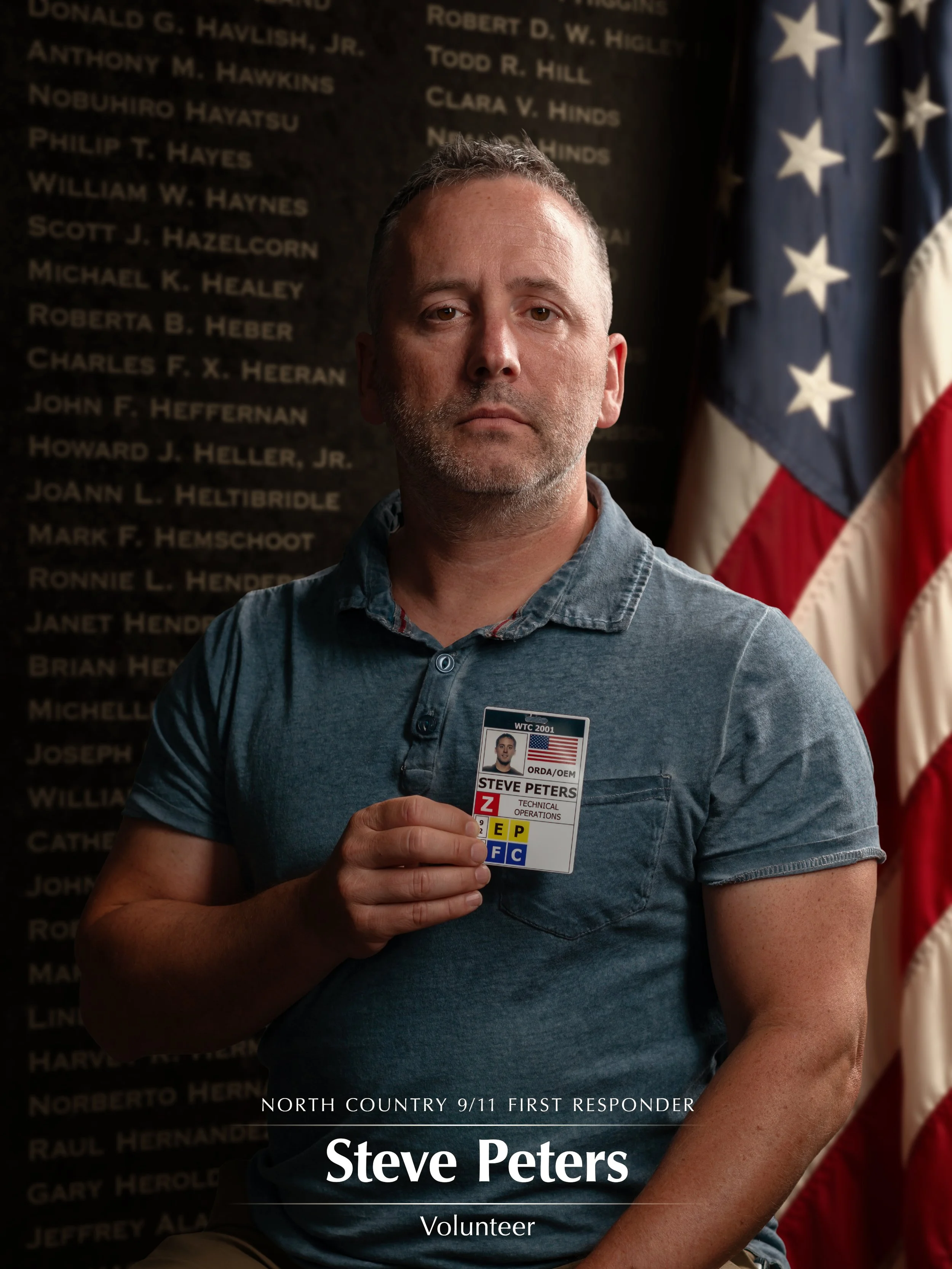
New York North Country 9/11 First Responders
This 9/11 portrait project exists to remember the people behind the numbers and to make sure their stories are not lost to time. Portraits, names, and personal stories, of North Country men and women who responded to 9/11, including those who later lost their lives to illnesses caused by their service at Ground Zero. They were not from New York City, but they answered the call anyway. This project is about service, sacrifice, remembrance, and the responsibility we have to never forget what they gave.
For me, this project has become something deeply personal and unexpectedly cathartic. When I returned home from Ground Zero, I was young, and I believed I was alone in what I had experienced. I carried those memories and feelings for years without fully understanding that thousands of others were carrying their own version of that same weight. Through this project, I have come to understand something I could not see back then: I was never alone. The people I am photographing and remembering are not just part of history, they have helped me finally understand my own place in it.
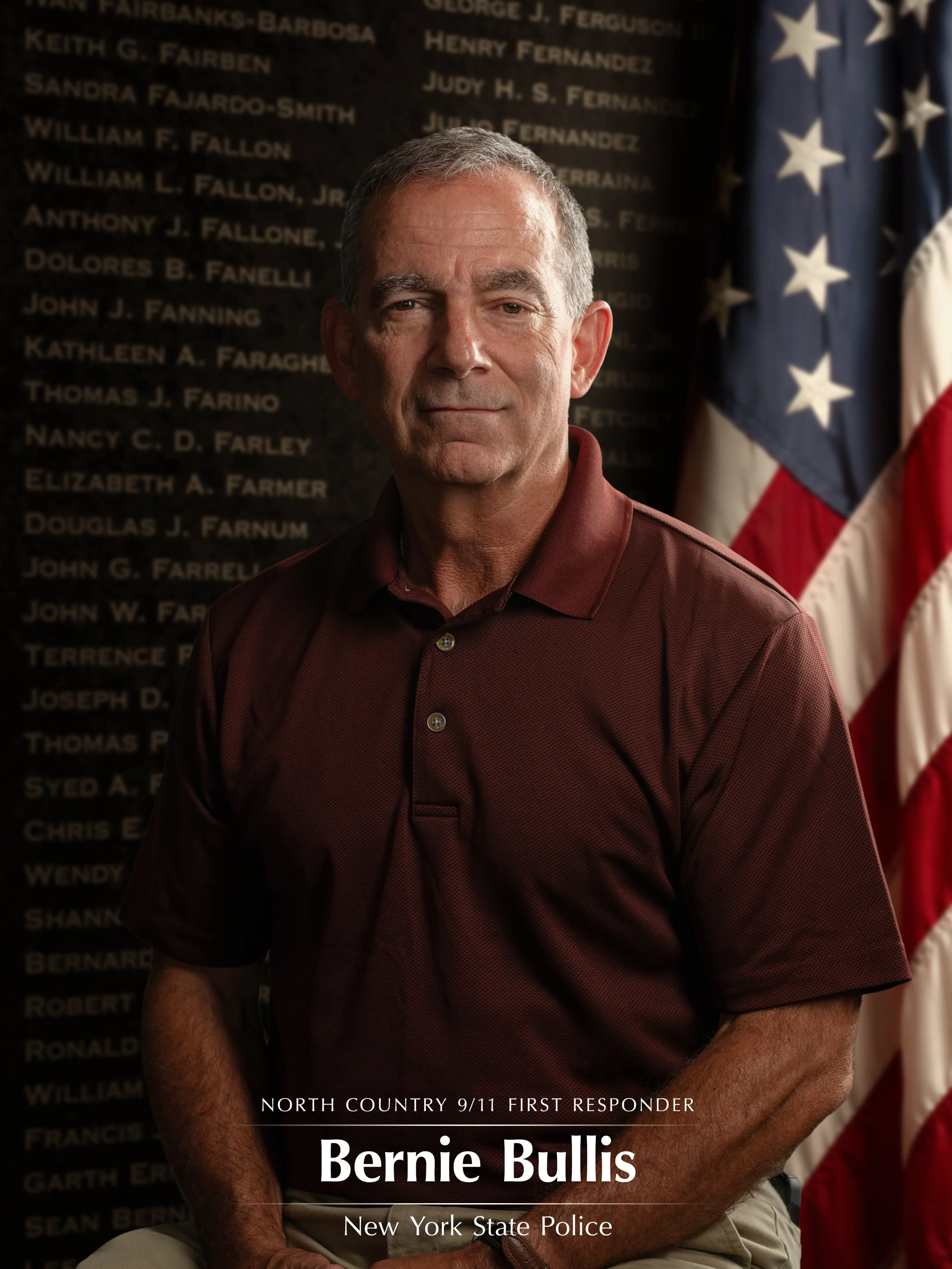
When we received our orders to respond to the World Trade Center disaster on week #2, we all felt a sense of duty and pride that most of us have not felt since the Academy or since completing prior military service.
We had a group of approximately eight Troop cars heading from Troop B down I-87 to NYC. When we arrived and traveled down Westside Highway, we were met by NYC residents holding signs and cheering for us for approximately 2 miles as we proceeded to the Javits Center in Manhattan. We didn’t know this at the time but the Javits Center would end up being our Headquarters for the next year.
The gratitude by the people of New York City was amazing and it kept us motivated as we completed our duties at Ground Zero and the surrounding perimeter of which we were responsible for from Canal Street south to the tip of Manhattan.
It is hard to believe that 25 years have passed since September 11, 2001. I remember where I was and what I was doing when I got the call.
That day changed our country forever. It also changed my life.
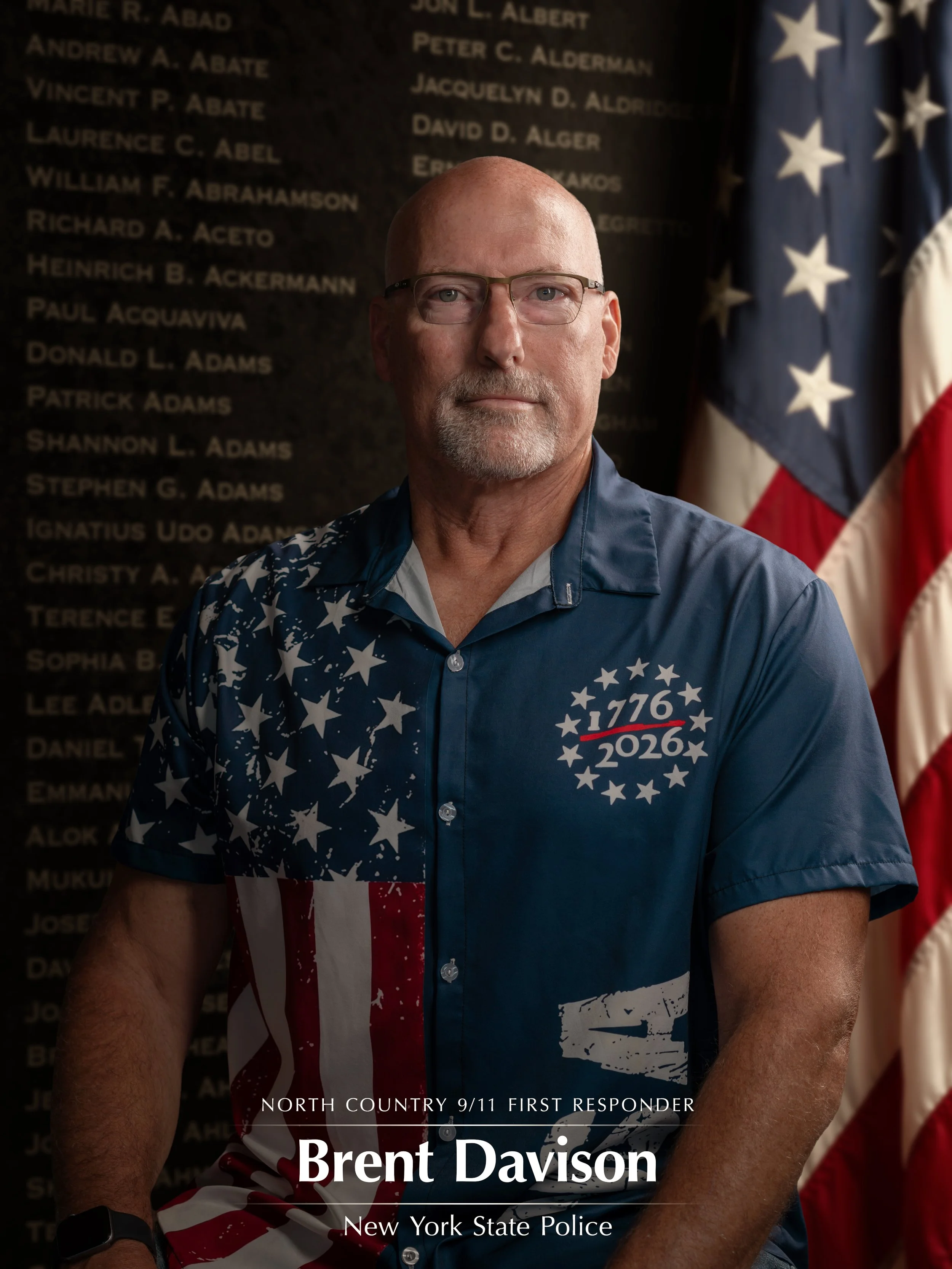
As a New York State Trooper, I responded to New York City following the attacks on the World Trade Center. Like thousands of other first responders, we went because there was work to be done and people needed help. At the time, none of us could have imagined that the consequences of those days would follow so many of us for the rest of our lives.
Years later (2018), I was diagnosed with a 9/11-related throat cancer. I was fortunate. I fought it, and today I am still here.
Several friends and fellow Troopers weren’t as fortunate.
Over the years, I have watched men I knew, respected, worked beside, and called friends battle cancers and illnesses connected to their service following 9/11. Some of them lost those battles.
That is a part of September 11 that continues even 25 years later.
For me, 9/11 will never simply be something I read about in a history book or remember once a year. I remember the people. I remember the devastation - the sights, sounds and smells. I remember Americans coming together. And I remember those who answered the call without knowing what that service might ultimately cost them.
Surviving cancer also changed the way I look at life. It deepened my appreciation for my family, strengthened my faith, and reminded me that the time we are given is a gift — and that we should use it in service to others.
So today, I remember the nearly 3,000 people who were taken from us that morning. I remember the first responders who ran toward danger. I remember those who have died in the years since from 9/11-related illnesses. And I pray for those who are still fighting those battles today.
Twenty-five years later, the promise remains the same:
We will never forget.
Major Brent Davison (retired)
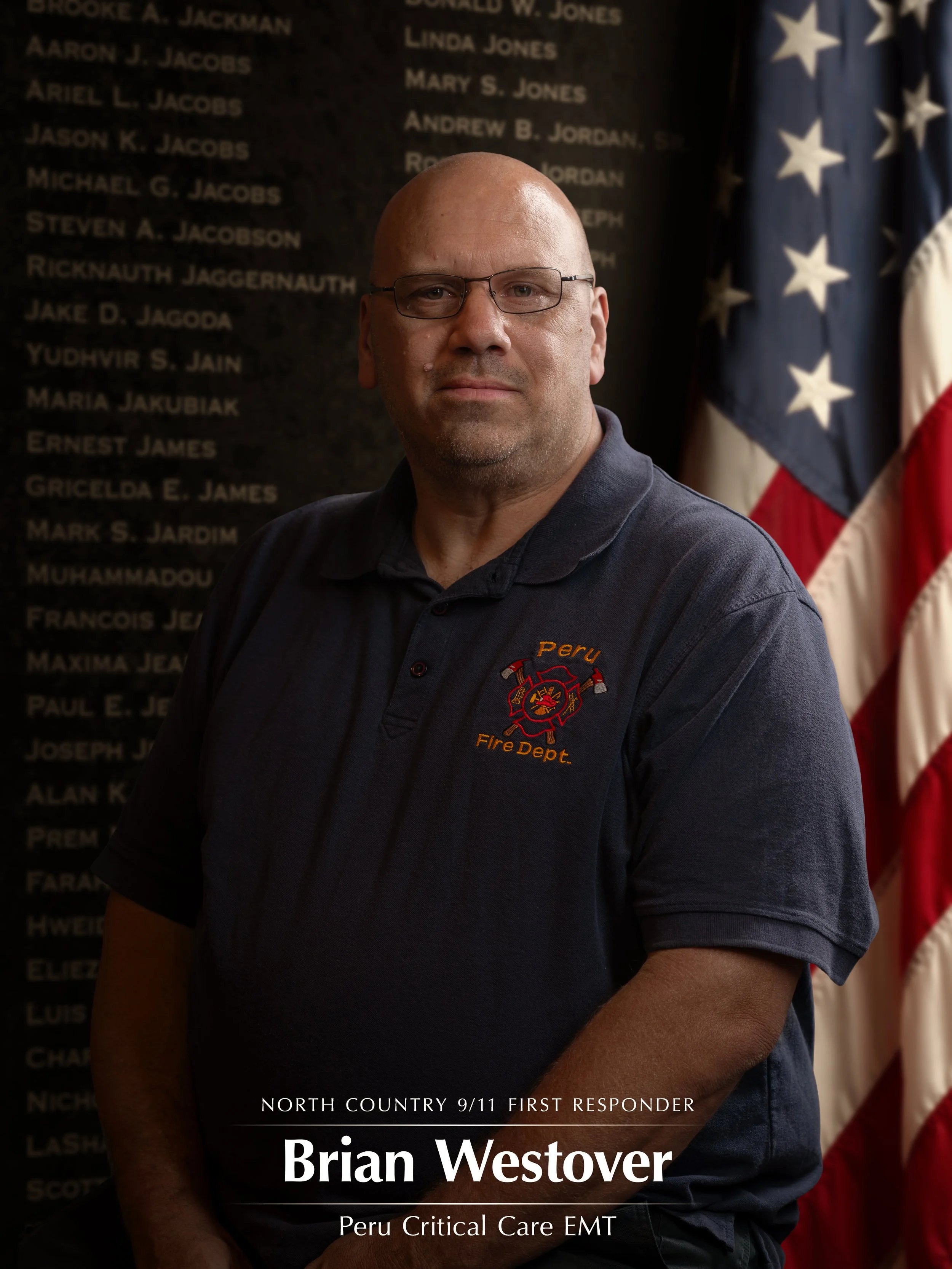
On 9/11/01 I was a critical care EMT and was deployed to New York City after the terrorist attacks. I was assigned to an ambulance at Ground Zero on September 23rd. While deployed we were assigned to the Verizon building for the Verizon employees to restore phone service to lower Manhattan.
My Time at Ground Zero –
I remember the drive down to New York City. As our convoy of ambulances from the North Country traveled down the interstate, people stood on bridges and along the roads, waving American flags and saluting us as we passed. It was something I will never forget. The country was hurting, but the support and patriotism we saw along the way were overwhelming.
When we arrived at Ground Zero, everything felt different. Walking around “the pile”, seeing the destruction and knowing that so many people had lost their lives was almost impossible to comprehend.
One moment that has stayed with me more than anything happened while we were working at our post adjacent to “the pile.” Suddenly, everything became completely quiet. You could have heard a pin drop. The firefighters and other rescue workers would use microphones and listen down into the holes and crevices of the rubble, hoping to hear signs of life.
When that entire site suddenly went silent, you knew something had happened. They had either located someone in the rubble or they were listening as carefully as they possibly could, hoping and praying to hear a voice or some indication that someone was still alive.
Standing there in that silence is something I will carry with me for the rest of my life.
I lost a close friend and brother firefighter who responded to NYC the same time I did, to 911 illness.
Scotty LeFlesh will never be forgotten.
9/11 changed all of us. I will never forget the people we lost, the people who searched for them, and the incredible strength of everyone who came together in the aftermath.
Never Forget.
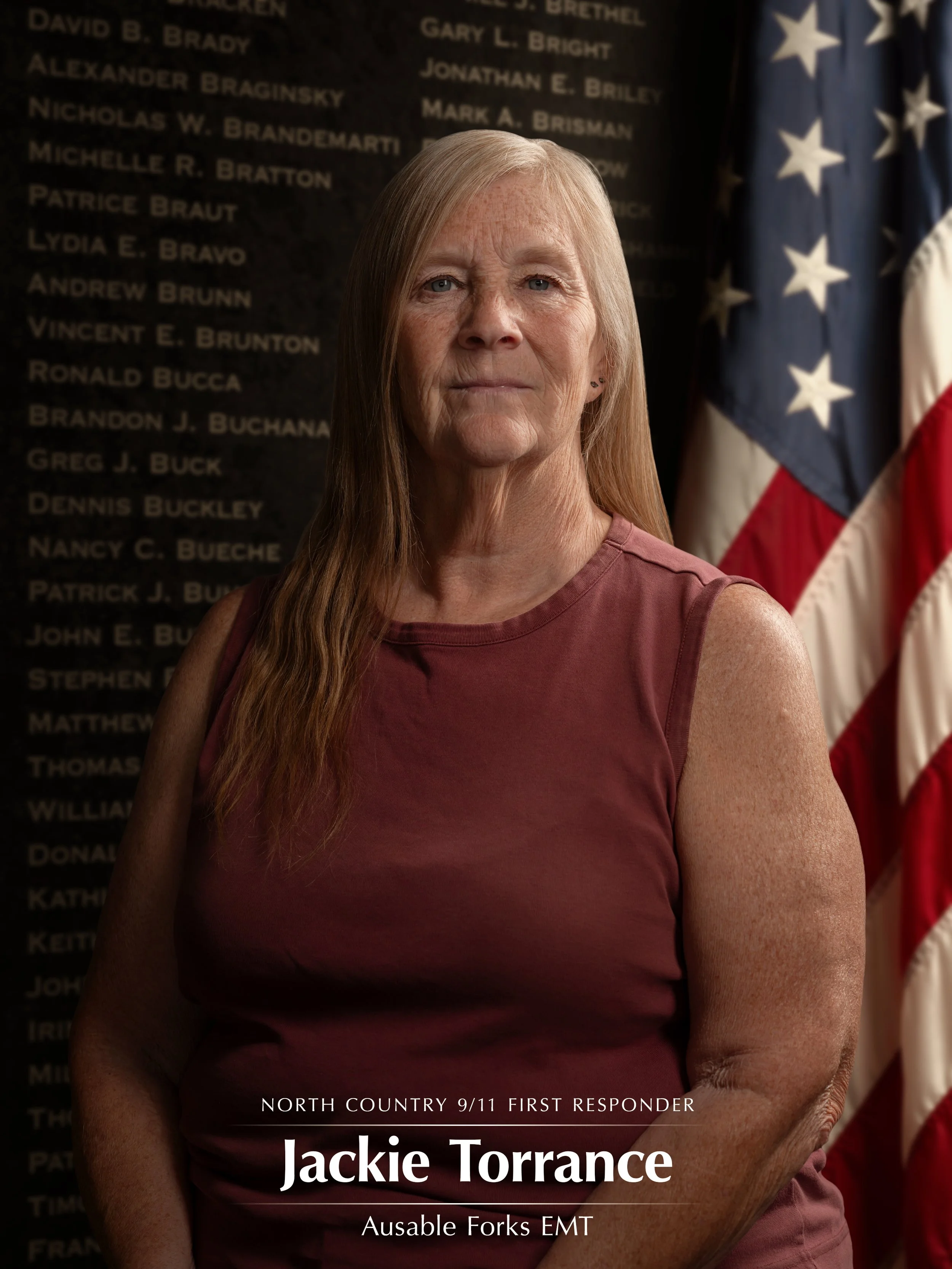
We are stationed 1 block from the rubble that steaming, smoldering pyramid of twisted
steel and broken concrete-knowing could still be people buried alive. Understanding
completely why FDNY won’t give up on their fellow firefighters, police and EMS. The
face of one firefighter, with his vacant look out the bus window driving by our rig will
forever stay with me. The burning rubble smells like wet campfire here-everything is
covered with ash. The church in the middle of all this is untouched; truly divine
intervention. What struck me most is seeing the graveyard behind the church-not a
gravestone toppled, and lots of ash and everything from financial paperwork to pictures
to an mylar Easter balloon deflated.
I talked to an FDNY guy this morning who released us this morning at 7:30. He said
they found a number of people in the elevator-all dead; the bodies were intact. He said
the CO levels are getting dangerously high.
(From Jackie's personal diary)
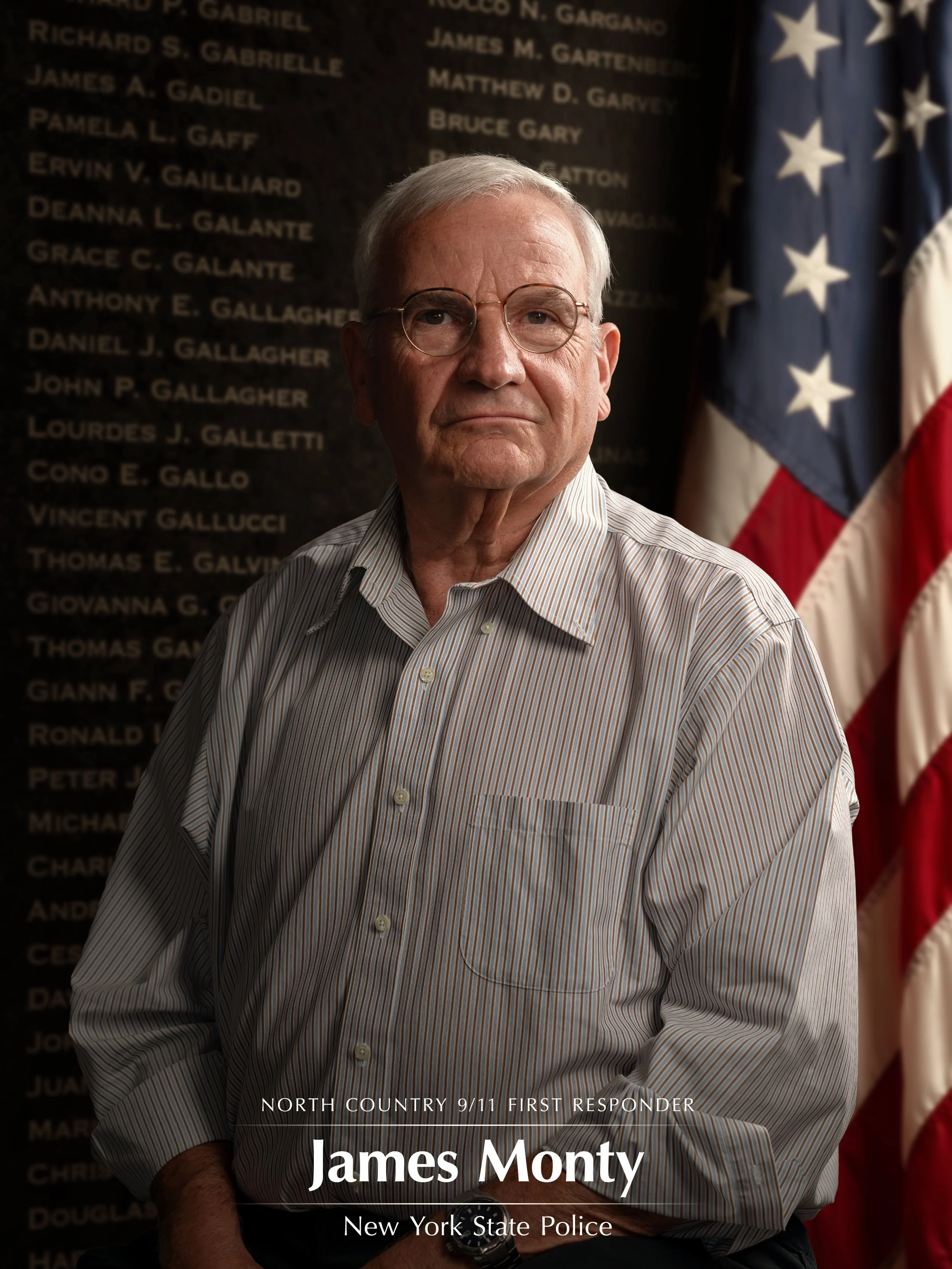
I joined the New York State Police in 1984.
On the morning of 911, I was working a day shift. The day shift was at a local coffee shop when my wife called me and said, “Get to a TV, Something is happening in New York City!” We returned to our station and turned on the TV just as the second plane hit the World Trade Center. After the initial shock we signed additional weapons from the station armory and awaited further orders. I said to my partner “I wonder where we will be in the state by the end of today”. The call came in and half the shift including myself were sent to the local border crossing to assist US Customs and the other half were told to go home, pack a bag and prepare to be deployed to NYC.
While assisting US Customs, everyone was guessing who was responsible for the attack, what would be their next act and what would be our response. On the Sunday prior to 911 I was at the Buffalo Bills vs New Orleans Saints football game and looking back I could only imagine what it would be like if a plane had crashed into a major league or college football stadium. I also thought to myself that our children would never know the freedoms I grew up with,
On the Saturday following 911, I was sent to NYC for a week. The New York State Police rotated us in and out of NYC for a week at a time. I did seven weeks in NYC and my assignments ranged from traffic post, escorts and security details at various locations around NYC. One night my partner and I were assigned to a post just East of the pile and a weather front came in and forced the cloud down and we had to wear our gas masks while sitting in our troop car. At the time I was a New York State Troopers PBA delegate and in addition to the World Trade Center duties, I was handling issues with Troopers assigned to NYC, their home fronts and regular union related issues in Troop.
I continued as a uniform trooper for 21 years until 2005 when I was promoted to the BCI and assigned to the Counter Terrorism Intelligence Unit.
James ‘Jim MONTY, retired
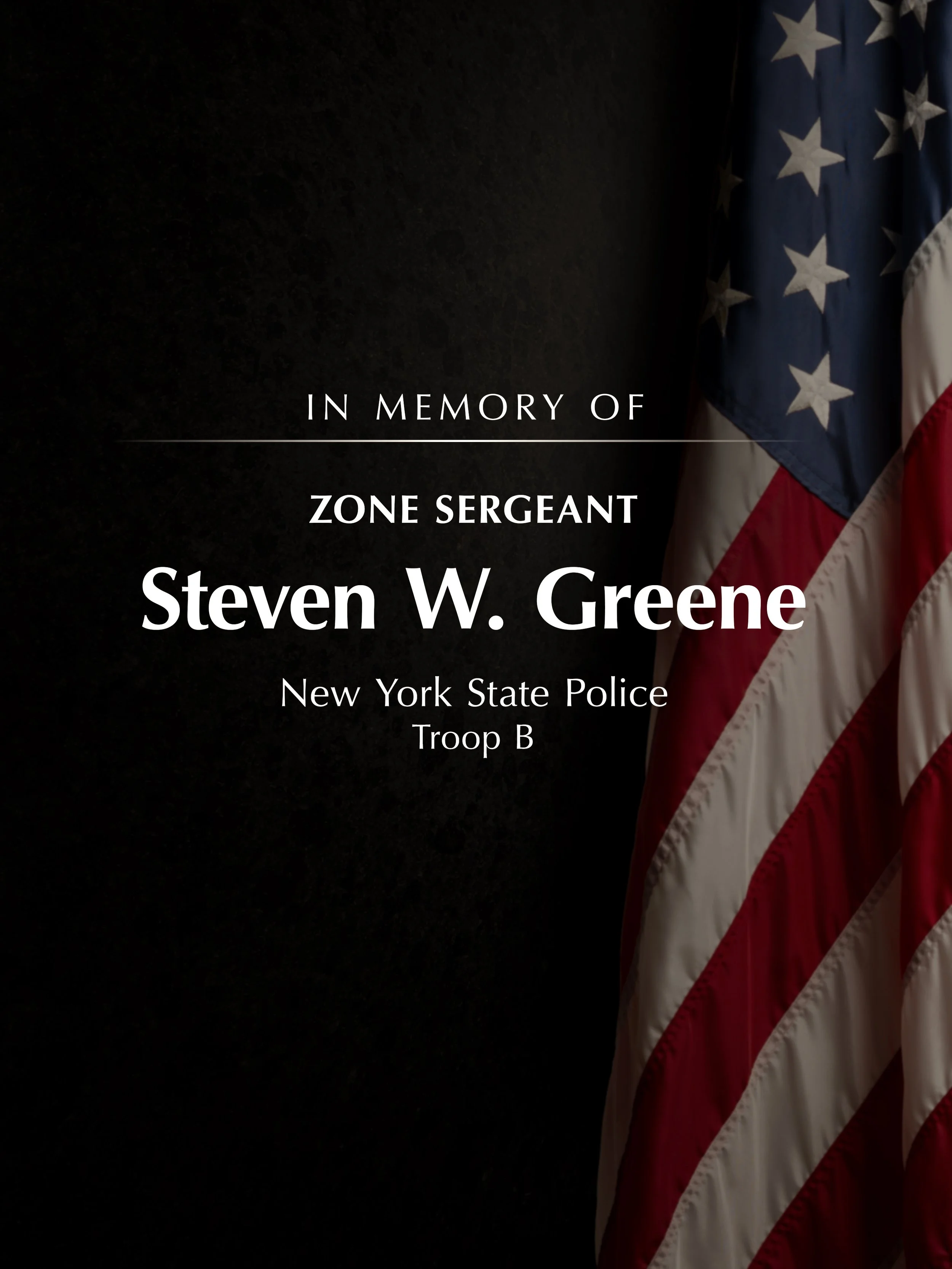
On September 11, 2001, I was at my brother’s house in Plattsburgh when one of his employees came in and said that we were “under attack.” We turned on the television and began watching the news. I was a Zone Sergeant with the New York State Police, working out of Plattsburgh. I called my supervisor, Captain Bruce Dunning, and told him that I wanted to go to New York City to help.
A group of us from the North Country was assembled, and we left in convoy for Manhattan.
I had it in my mind that we would get there and be able to help someone — anyone. We were given small “triage kits,” which essentially contained a few minor bandages and little else. When we arrived at Ground Zero and saw the severity of the destruction, we quickly realized the enormous scale of the disaster.
Our team ultimately played an important role at one of the temporary morgues. We were tasked with keeping the morgue secure while protecting the privacy and dignity of the victims and their families. At times, remains needed to be transported to the morgue, and our members were called upon to assist with that as well.
We also met family members who came to the morgue searching for information about their loved ones. The morgue was an extraordinarily difficult environment in which to work. Paparazzi attempted to photograph the remains. Curious people tried to enter secure areas. Families of the missing were exhausted, distraught, and desperate for answers.
Looking back, I believe the morgue was where our North Country troopers made one of their most meaningful contributions. We were there to answer the call, but our job became more than simply providing security. We helped protect the privacy and dignity of those who had lost their lives and showed compassion and respect to the families who were searching for them.
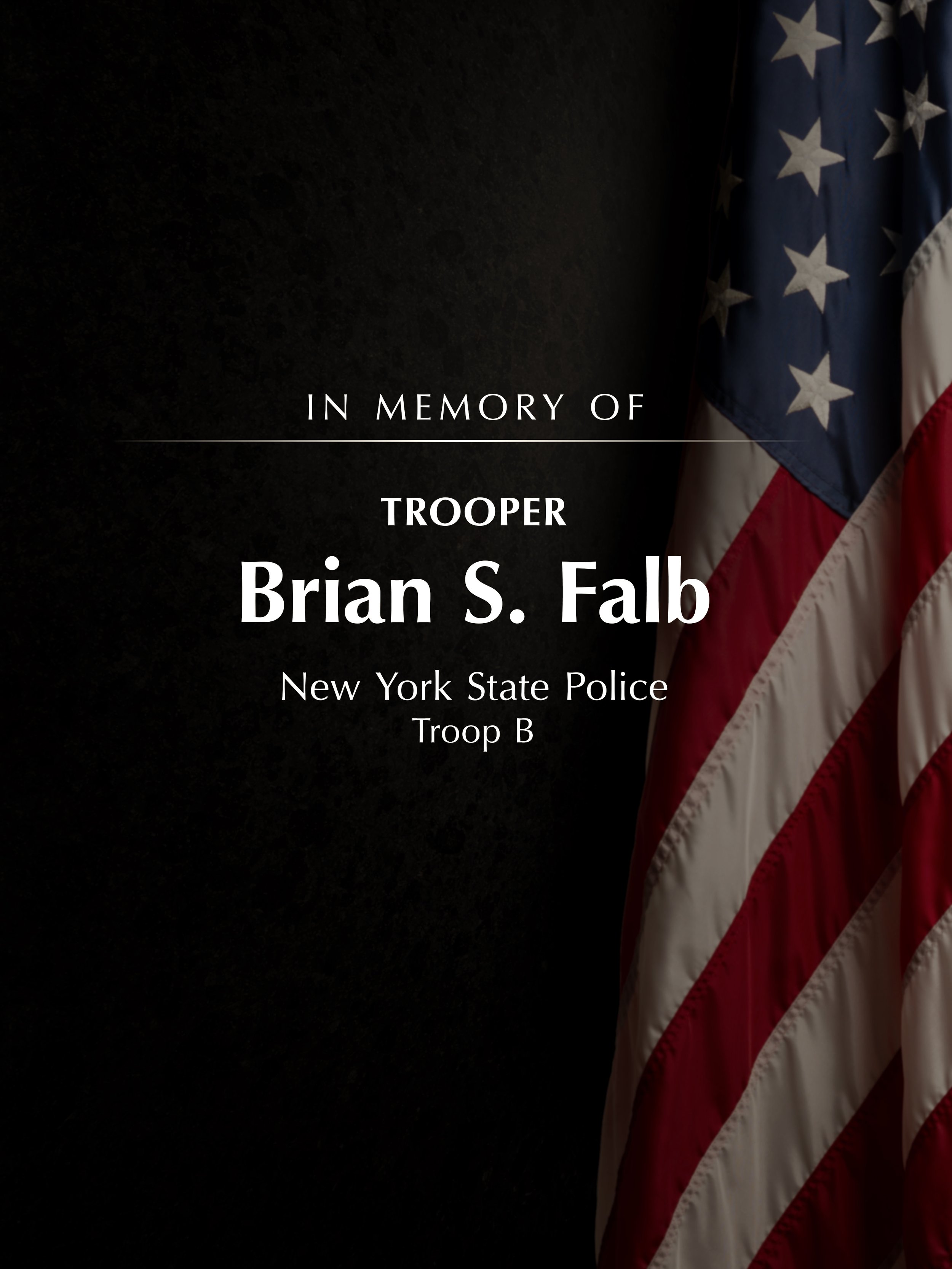
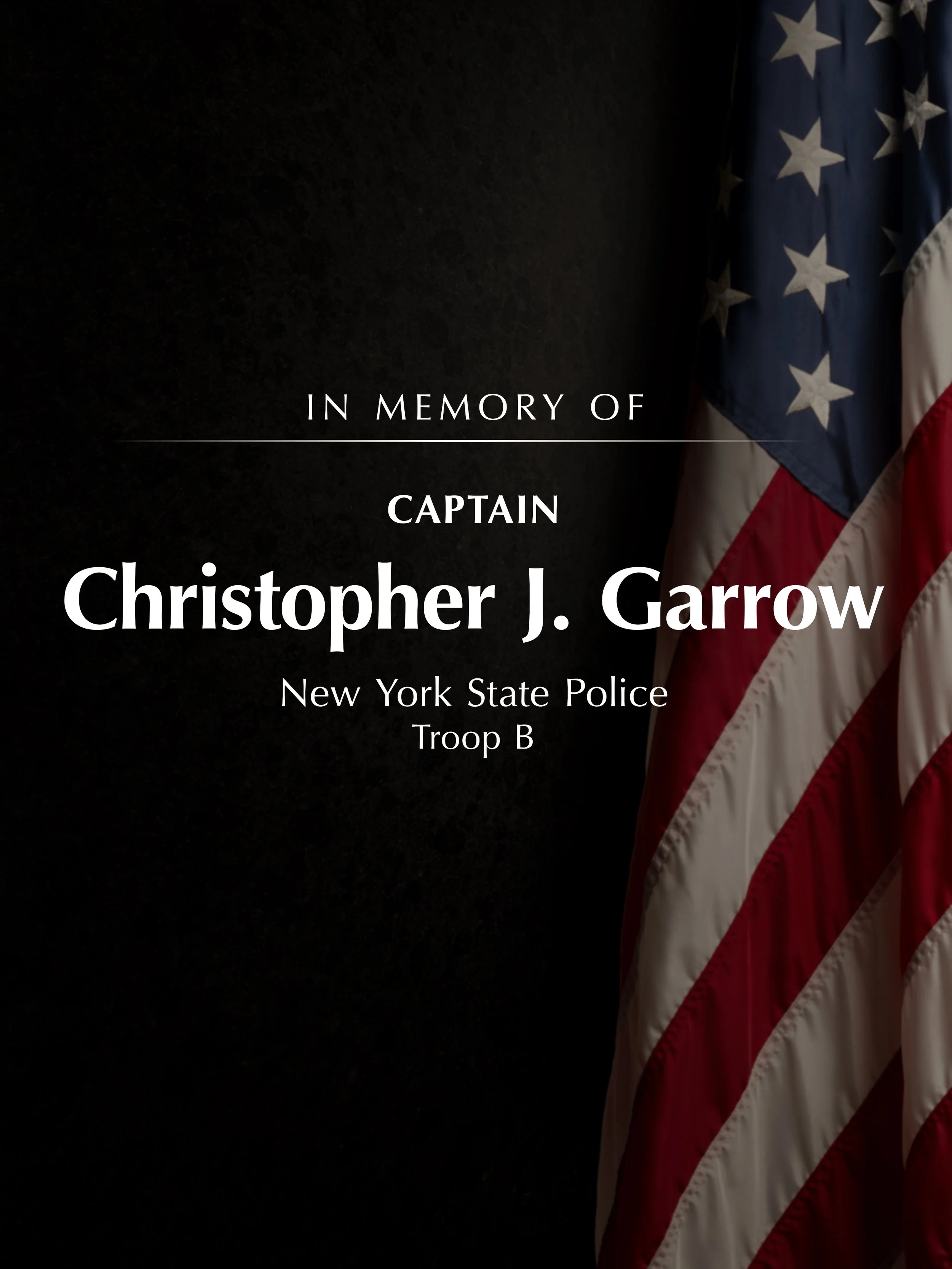
Two troopers assigned to me on 9/11, both from the North Country, ultimately lost their lives as a result of the attacks: Trooper Brian Falb and Captain Chris Garrow.
I take some solace in knowing that we were able to do our part to protect the dignity and privacy of the victims and their families during one of the darkest moments in our history.
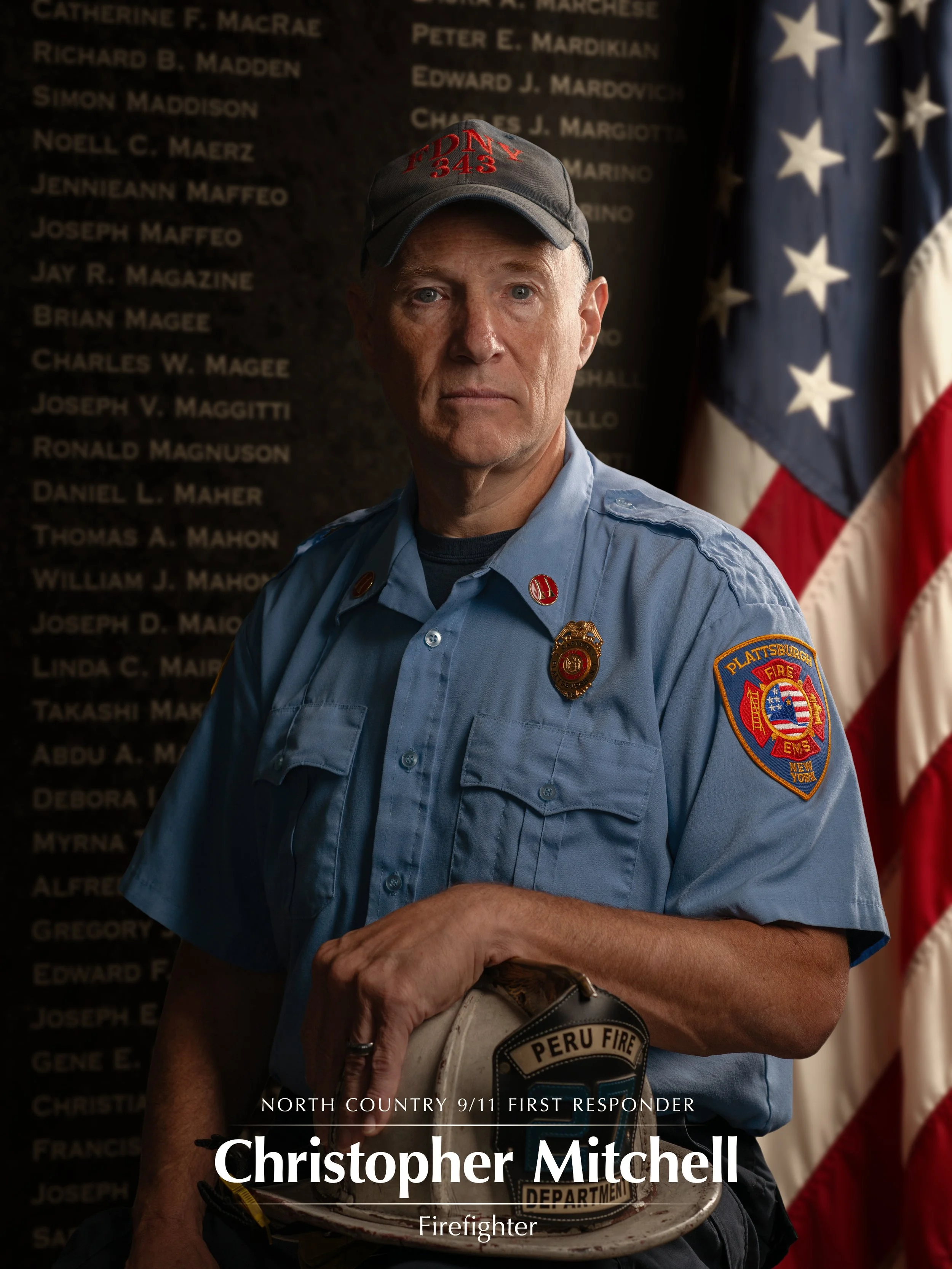
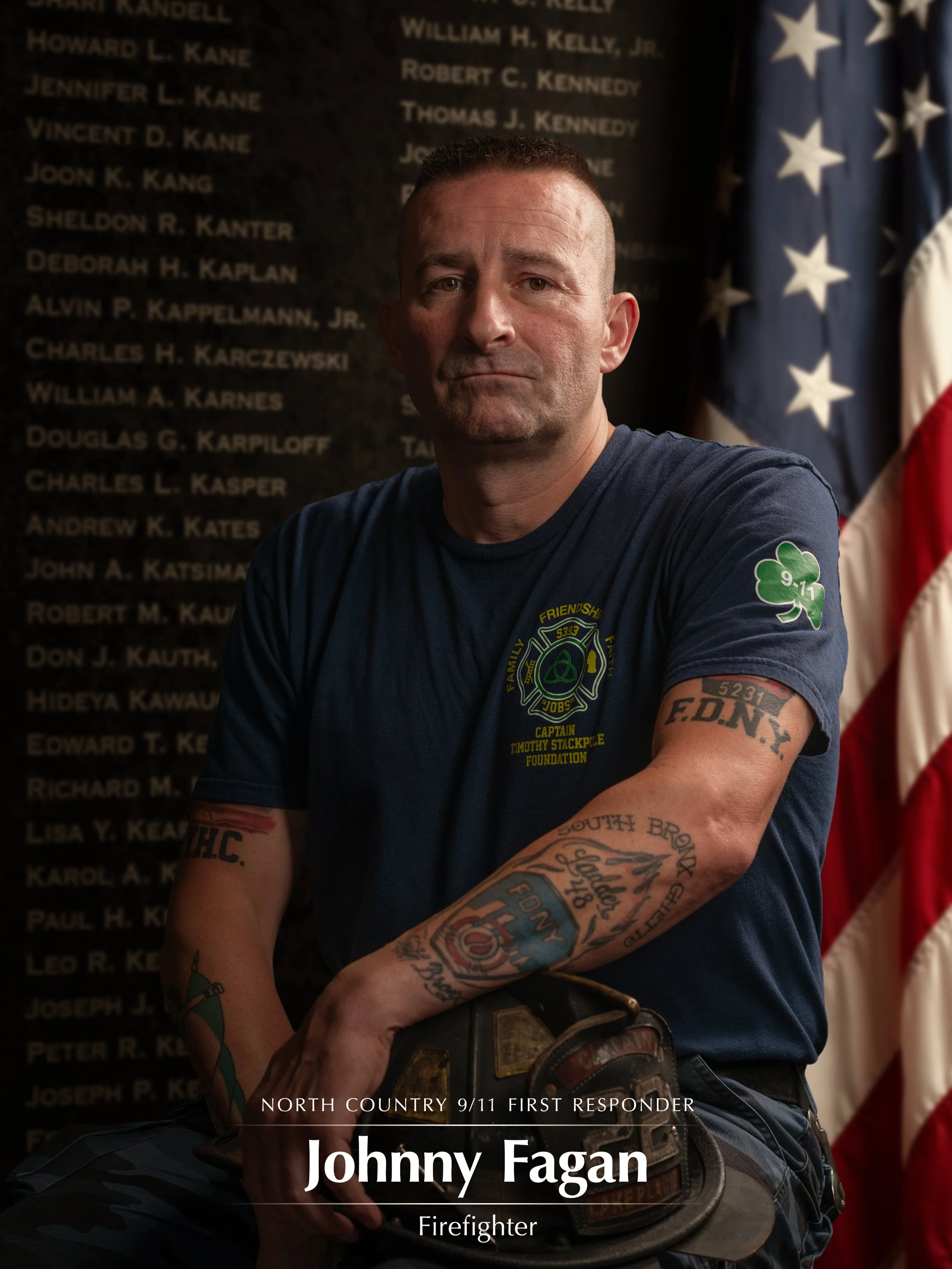
I arrived at the World Trade Center site on the morning of September 13th as a volunteer firefighter, wanting to help in any way possible. The landscape there was one of complete destruction. It was as if Armageddon had occurred.
I made my way to Liberty Street, where the quarters of FDNY Engine 10 and Ladder 10 were located, using the firehouse as a reference because almost everything else was unrecognizable. The firehouse had been severely damaged but was still a focal point for first responders.
At that point, it was time to climb onto the pile to help dig and move debris with the other responders, holding onto any hope of finding survivors. In all the destruction, what stood out to me was that everybody was helping everybody. As you made your way up the “pile,” ironworkers were there to pull you up to the next high point so we could help dig and search. Fire departments from across the country were there, all helping—Boston, L.A., Chicago, Miami, and many others.
K-9s and their handlers were brought in to locate potential survivors. When a dog indicated a spot, listening devices were lowered into voids in the hope of hearing any signs of life. The nearest chief would call for quiet across the entire pile so the handler could listen. If the handler had any suspicion that he heard something, we would dig frantically and then have him listen again.
Unfortunately, no living person was found at that point. We found only deceased civilians, who were respectfully placed in body bags and passed down our human chain to the street and the temporary morgue.
In the chaos, there was a constant fear that other buildings could collapse around us. At a few points, personnel were ordered to evacuate immediately by chiefs with bullhorns, and hundreds of men would run for their lives down the street. At that point, everybody knew anything could happen.
But if you were high on the “pile,” you could not run. It was simply not possible. So you stood there, hoping for the best, waiting a moment, and then going back to work.
All the chiefs there were incredible, but you could almost see them age in front of you because they did not want to see anyone else perish, and because of the immense pressure they must have felt.
This experience inspired me to take the next exam process the FDNY offered in 2002. I was fortunate enough to fulfill that dream and be hired by the FDNY. I was able to work with and learn from some of the best firefighters in the world, first being assigned to the South Bronx and later to Lower Manhattan.
The biggest takeaway from the tragedy of 9/11/01 that I carry with me 25 years later is the unity that was felt at the site. Firefighters, police officers, EMS, ironworkers, doctors, nurses, civilians—people of all colors and ages—all simply wanted to make an unimaginable tragedy a little better by doing whatever they could to help others.
Twenty-five years later, we must never forget.
I used to live in Orange County, NY so going to NYC was nothing new to me. When 9/11 hit, I was working for the NY State Police and I had less than two years on the job. I was sent to NYC for the first time on September 24, 2001 and I went down a total of four times.
Upon arriving in NYC in September 2001, the feeling was that of desolation. There wasn't any traffic and I didn't see many people. The people that were out held signs to thank us for being there or yelled out "thank you" as we drove by.
I was assigned to the escort detail for my first week in NYC. That detail meant my partner and I were assigned to drive people to wherever they needed to go.....ground zero, the morgue, the airports, wherever. It was surreal to drive around and not see NYC hustling and bustling like it normally did no matter what time of the day or night you were there. As I drove by the buildings, I remember thinking, "What if that building comes down next. I don't want to leave my daughter an orphan." It gave me a new understanding of not taking anything for granted.
During that time of grief, I saw people from all walks of life come together to try to deal with the devastation and loss. I also saw a city come together and work together to rebuild, to show that NY wasn't giving up. I'll never be glad that 9/11 happened, but I am honored to have been a part of living the history, and doing my part to help how I could.
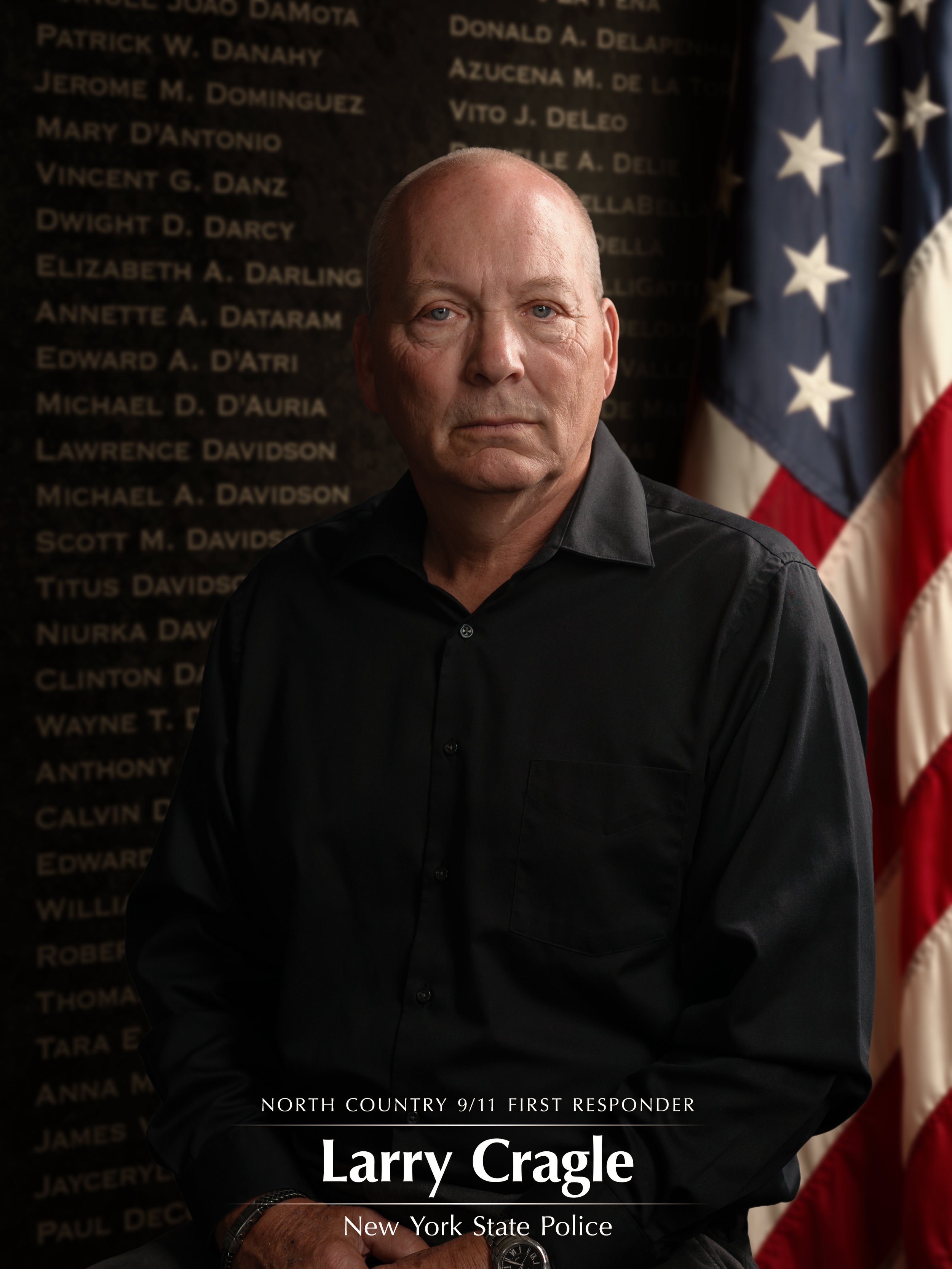
My most vivid memories of 9/11 begin in the morning. I was outside playing with my 3 year old son when my father unexpectedly pulled into my driveway. As he got out of his truck, I noticed a very concerned look on his face. I asked him what was going on and he said we were being attacked. That planes had flown into the World Tarde Center. The look on my father's face will forever be engrained in my mind, and is the first thing that comes to mind when 9/11 is brought up. The other memory is the mass destruction I saw upon arriving at the World Trade Center. I had watched news coverage and recall seeing people flee as the Trade Center came down, but did not fully comprehend the amount of damage that had occurred. That was brought into perspective when I arrived at the World Trade Center site that evening. The amount of destruction was massive, and unforgettable. The roads were covered with burnt out fire trucks and police vehicles, too many to count. There was debris from the destroyed office buildings scattered everywhere. Then there was the "pile", it was massive, towering over everything, smoke coming from it and people working frantically looking for survivors.
Larry E. Cragle
New York State Police, Retired
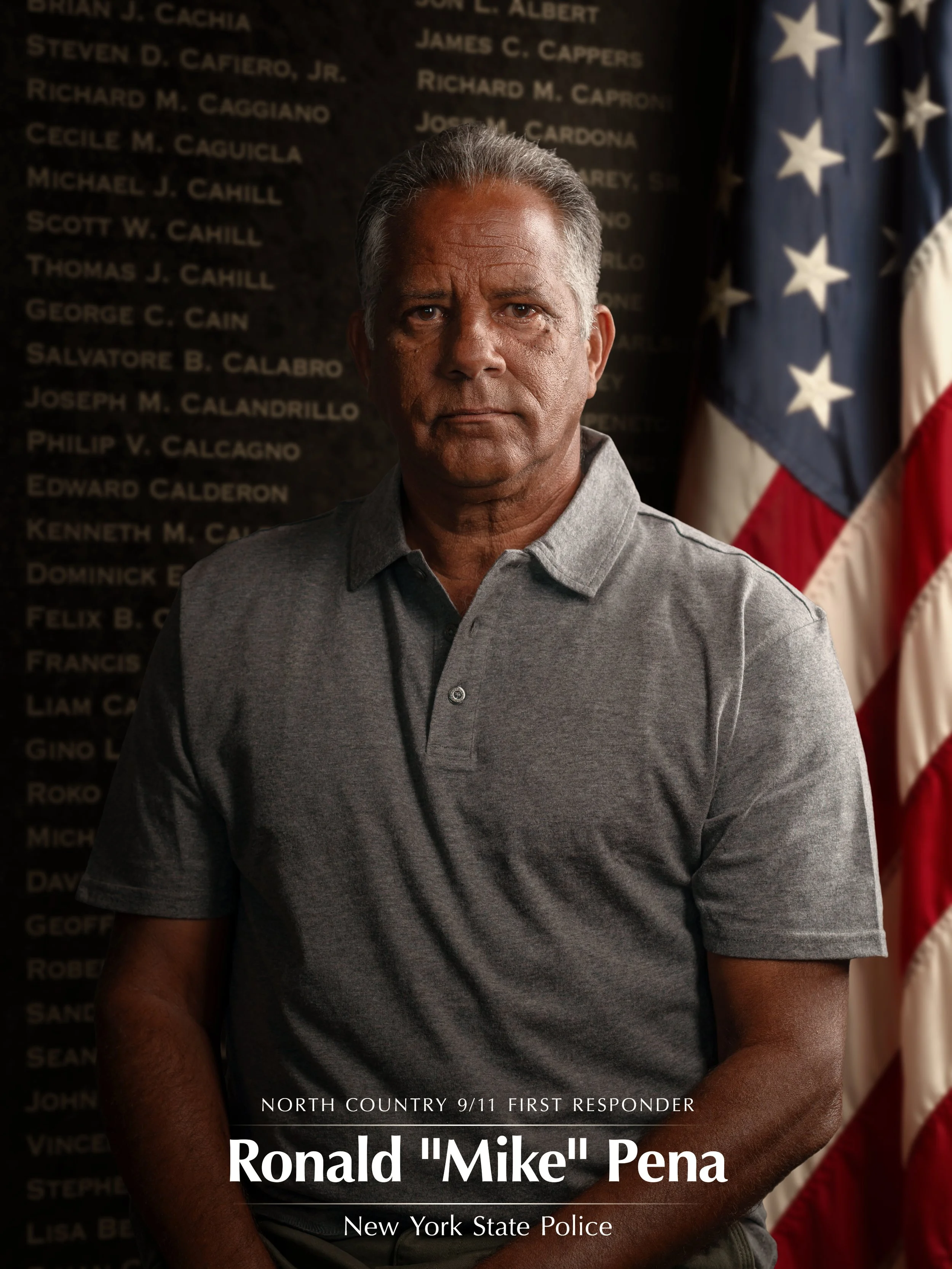
I was at the NY State Police Academy on the morning of Sept 11, 2001, when the attack happened. I was immediately ordered back to Troop B for possible response. I deployed 4 different times between Sept 2001 and February 2002 in response to the attacks by the NY State Police. As a member of the158th FW, VT Air National Guard, I also participated in CAP missions providing air cover over New York City.
Ronald "Mike" Pena
Retired - NYSP, Technical Sergent, Troop B Sr. Firearms Instructor.
Msgt, US Air Force, retired.
September 14, 2001
Three days after the attack on the World Trade Center, I traveled to New York City as part of a mutual aid response as a volunteer Advanced EMT with Morrisonville-Schuyler Falls Ambulance Service. We were there to help in whatever way we were needed. Our initial assignment was shared that we would be assisting in the on-site temporary morgue but once we arrived we were given a 12 hour shift for firefighter rehab – assisting injured personnel at the scene.
Our assigned post was near the intersection of Broadway and Vesey Streets, near St. Paul’s Chapel. I don’t remember every detail of that time, and there are some thing I remember – the overwhelming devastation, the unimaginable loss of life, the incredible amount of debris covering the streets and the cemetery.
But more than anything, I remember the quiet. The only sound from the rubble at that corner were back-up alarms from construction vehicles and crane assembly – not the usual hustle and bustle of the NYC I had visited before and since.
After seeing the events of September 11 on television, it was difficult to comprehend that what we were seeing was real. Being there, standing so close to the layers of building toppled onto the streets, made it real in a way that television never could. There had been so much life in that place, and suddenly there was so much loss.
Some things stay with you without being put into words.
What I do know is that the experience changed me. It made me think differently about how quickly life can change and about what I wanted my own future to look like.
Twenty-five years later (April 2026), I returned to Ground Zero and visited the 9/11 Memorial and Museum. I was overwhelmed, crying throughout the entire museum. Even after all those years, the experience remained very close to the surface. Some memories don't need to be described to be remembered.
I went to New York in 2001 because I was part of a team that was needed. I left with memories I will carry for the rest of my life. And 25 years later, I still remember the devastation, the silence, and the feeling that life had changed—both for our country and for me – realizing how fragile life is and that the future isn't guaranteed.
I was a member of the New York State Police Mobile Response Team when the disaster happened. I was in Albany when our team was activated to assist in the search and recovery efforts. On September 12 we were flown down to the site by helicopter. I remember as we approached the city seeing the smoke rising from the area. When we got to ground zero it looked like a war zone. Skyscrapers were reduced to rubble. The area was unrecognizable. I thought where do we even begin. We joined a group on the rubble pile and started an assembly line of removing debris a bucket at a time, hoping to find someone alive. We continued our search efforts in the midst of the disaster, hoping in some small way to make a difference. I recently visited ground zero. It is hard to believe the rubble pile existed. New buildings, memorials, the area is now unrecognizable compared to the ground zero that existed during our search efforts. A testimony to the efforts of all involved in the massive cleanup of the area. At times it seems like it was just a bad dream.
In the days following the September 11, 2001 terrorist attacks, I was given the unexpected opportunity to travel to New York City as part of a team assisting with security and credentialing at the Emergency Operations Center on Pier 92. It became 15- to 18-hour days, during which our team produced more than 5,000 secure credentials for emergency personnel, government agencies, law enforcement, and relief workers. Working in the center of the recovery effort exposed me to extraordinary grief, exhaustion, tension, generosity, and unity as thousands of people worked together in the aftermath of the attacks. I also spent time at Ground Zero, where the scale of the destruction, the continuing fires and search efforts, and the eerie absence of normal life were almost impossible to comprehend. I worked next to the family assistance center, where walls covered with photographs of missing husbands, wives, parents, children, friends, and coworkers transformed an enormous national tragedy into thousands of individual human stories. The experience gave me a profound appreciation for the responders, volunteers, relief organizations, and ordinary people who came together during one of the darkest moments in American history, and it permanently changed the way I understood both the tragedy of September 11 and the capacity of people to respond to adversity with courage, compassion, and service.
The experience did not end when I left New York. When I returned home, I struggled with depression, and my grandmother died only a few weeks later. Things were spiraling, and I knew I needed something to move toward. I enrolled in a Skeleton School in Lake Placid, became a member of USA Bobsled & Skeleton, and began trying to become a skeleton athlete. I was not very good, but that did not really matter. Skeleton gave me focus, purpose, and a way forward.
About three and a half years later, I was offered a job with USA Bobsled & Skeleton—a job I had no business getting. I was likely the only person willing to work for $15,000 a year. I had a tremendous amount to learn, and being thrown into high-level sport forced me to grow quickly, work at a higher level, and make plenty of mistakes along the way.
I ran bobsled and skeleton programs in Lake Placid and eventually oversaw programs in Park City as well. I organized America’s Cup, World Cup, national team and Olympic Trials competitions, and created a technology program for skeleton. I wrote grants, brought in hundreds of thousands of dollars, and worked with our technical team to develop American-made sleds. In 2010, John Daly, a SUNY Plattsburgh graduate and All-American decathlete, rode our sled at the Olympic Games. In 2014, the U.S. skeleton team won a silver and a bronze medal on equipment from our technology program. The athletes earned those medals, but our program gave them the tools they needed to become better drivers.
The lessons I learned in international sport followed me. I spent ten years as Superintendent of Recreation for the City of Plattsburgh, where I had the opportunity to build programs and make a meaningful difference in the lives of many people. Later, after another series of difficult experiences, I started Adirondack Coast Sports, a business focused on events and youth and adult sports programming.
That leaves me with a difficult but undeniable line through my life: my experiences at Ground Zero contributed to a depression. Depression pushed me toward skeleton. Skeleton led to a job I was not prepared for. That job forced me to grow, helped lead to Olympic success, and shaped the work I later did in public recreation and in my own business. This work continues.
Had the towers not fallen, I almost certainly would not have followed this path. There is no consolation in that, and no balancing of the scales. Nothing that came afterward can justify or diminish the loss of September 11. But I can clearly see how one terrible event altered the direction of my life, and how finding something to move toward during one of my lowest periods ultimately shaped nearly everything that followed.